Jahir Sadik Monon
PhD student, Computer Science, University of Massachusetts Amherst


LGRC A308, UMass Amherst
Amherst, Massachusetts
Hello, I’m Jahir, a second-year MS/PhD student in Computer Science at the University of Massachusetts Amherst, advised by Dr. Shlomo Zilberstein in the Resource-Bounded Reasoning Lab and co-advised by Dr. Donghyun Kim in the Dynamic and Autonomous Robotic Systems (DARoS) Lab.
I study how embodied agents can make good decisions under limited onboard computation. My work spans VLA-based navigation for assistive robots — much of it part of our lab’s guide dog robot project — and perception datasets with synthetic data pipelines for blind and low-vision travelers. I am now moving toward small VLA models and multi-agent collaboration among compact foundation models, building on my earlier work in decentralized multi-agent RL and representation learning.
Before UMass, I was a research assistant at CCDS, Independent University Bangladesh, where I worked on VLM-based agent-centric representations for RL with Dr. Riashat Islam (Mila, McGill University & Microsoft Research), and on multimodal reasoning and LLM-based multi-agent collaboration with Dr. Amin Ahsan Ali and Dr. AKM Mahbubur Rahman of CCDS, IUB and Muntasir Wahed of UIUC. I did my B.Sc. in Computer Science and Engineering at the University of Dhaka, graduating with the Dean’s Honor Award; my thesis with Dr. Md Mosaddek Khan was on decentralized multi-agent reinforcement learning.
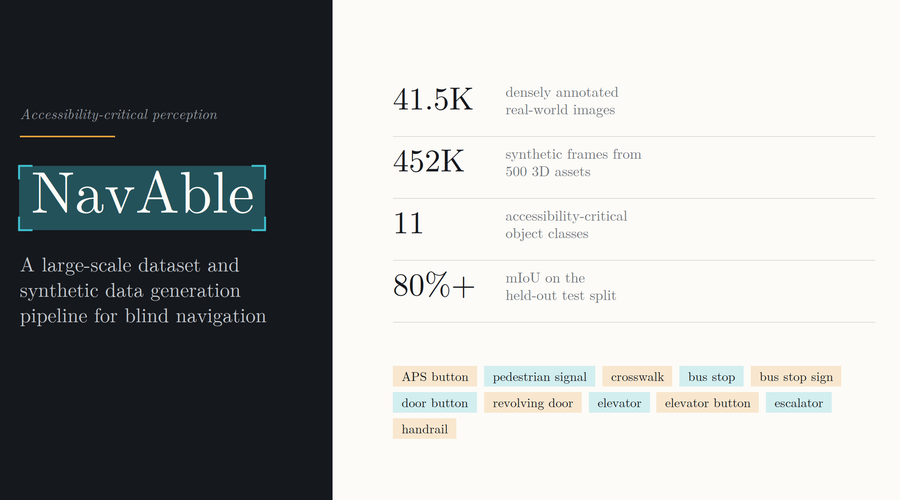
| Sep 24, 2026 | NavAble, my co-first-authored paper introducing a large-scale dataset and synthetic data generation pipeline for blind navigation, was accepted at NeurIPS 2026 (Evaluations and Datasets Track). |
|---|---|
| Mar 01, 2026 | Our paper GuideNav — my first as a graduate student — received an Honorable Mention (Systems Track, top 3.6% of accepted papers) at HRI 2026. |
| Jan 15, 2026 | Honored to receive the Paul Utgoff Memorial Graduate Scholarship from the Manning College of Information and Computer Sciences, UMass Amherst. |
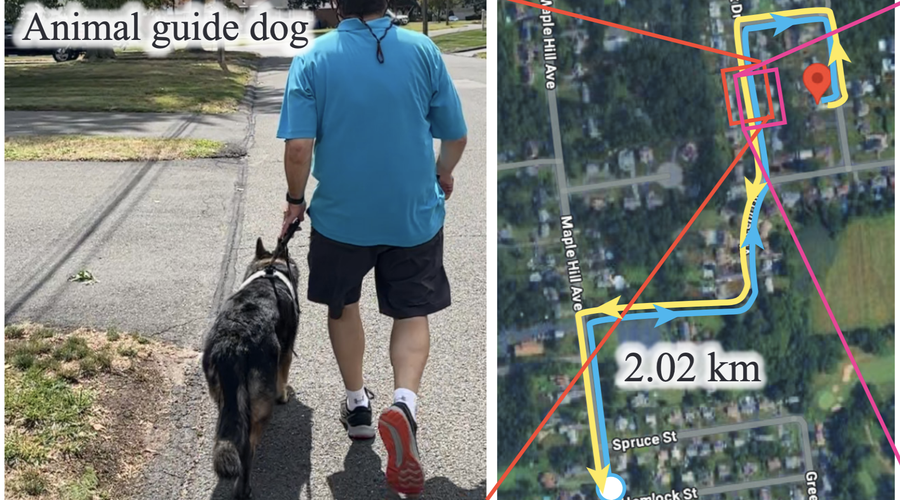
| Dec 05, 2025 | Our paper GuideNav, a vision-only robotic navigation assistant for blind travelers, was accepted at HRI 2026. |
| Nov 06, 2025 | Our paper BAPPA, a benchmark of agents, plans and pipelines for Text-to-SQL generation (with collaborators at CCDS), is out on arXiv. |
| Sep 02, 2025 | Started my MS/PhD in Computer Science at UMass Amherst, joining the DARoS Lab with Dr. Donghyun Kim. |
| Jun 01, 2025 | Received the Dean’s Honor Award and the Bachelor’s Merit Scholarship from the University of Dhaka. |
| Feb 04, 2025 | Awarded the National Science and Technology (NST) Fellowship by the Ministry of Science and Technology, Bangladesh for my RL research project (merit rank 11th out of 1260 candidates). Details. |
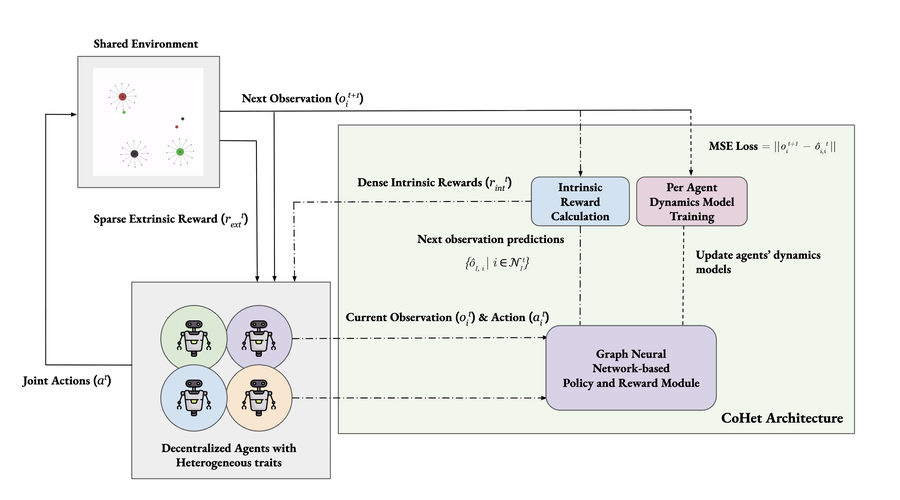
| Jan 15, 2025 | My undergraduate thesis research on heterogeneous MARL coordination (CoHet) was accepted as an extended abstract at AAMAS 2025. |
selected publications
See the full list of publications.