publications
papers, datasets and preprints in reverse chronological order.
2026
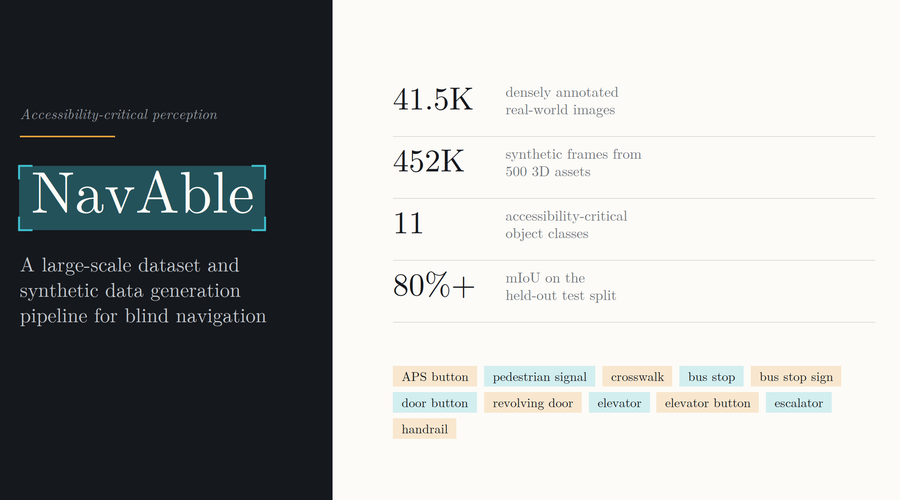
- NavAble: A Large-Scale Dataset and Synthetic Data Generation Pipeline for Blind NavigationHochul Hwang*, Jahir Sadik Monon*, Soowan Yang*, Sahil U. Patel, Anh N. H. Nguyen, Khoa Nguyen, Keshav Garg, Daniel Gage, Dawit Hordofaa, Anjna Anjna, Eshed Ohn-Bar, and Donghyun KimIn NeurIPS Datasets and Benchmarks Track (under review), 2026
@inproceedings{hwang2026navable, title = {NavAble: A Large-Scale Dataset and Synthetic Data Generation Pipeline for Blind Navigation}, author = {Hwang, Hochul and Monon, Jahir Sadik and Yang, Soowan and Patel, Sahil U. and Nguyen, Anh N. H. and Nguyen, Khoa and Garg, Keshav and Gage, Daniel and Hordofaa, Dawit and Anjna, Anjna and Ohn-Bar, Eshed and Kim, Donghyun}, booktitle = {NeurIPS Datasets and Benchmarks Track (under review)}, year = {2026}, } - GuideNav: User-Informed Development of a Vision-Only Robotic Navigation Assistant for Blind TravelersHochul Hwang, Soowan Yang, Jahir Sadik Monon, Nicholas A. Giudice, Sunghoon Ivan Lee, Joydeep Biswas, and Donghyun KimIn Proceedings of the 21st ACM/IEEE International Conference on Human-Robot Interaction (HRI), 2026
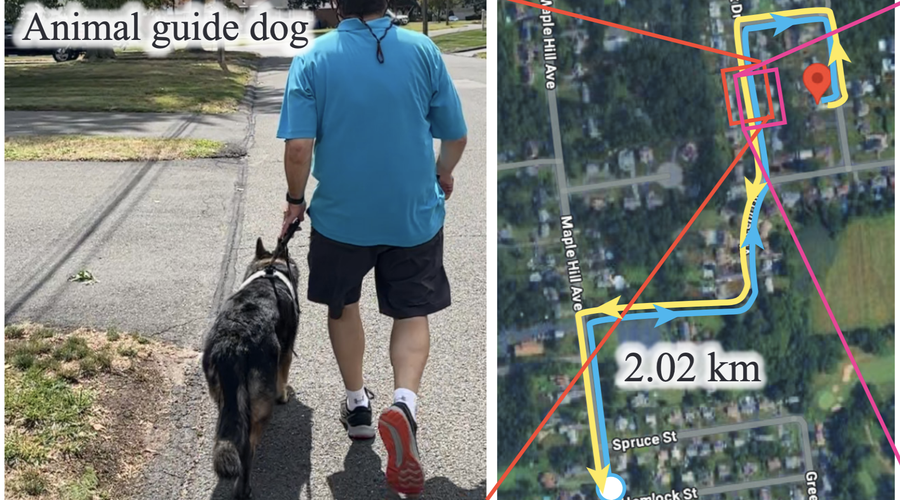
While commendable progress has been made in user-centric research on mobile assistive systems for blind and low-vision (BLV) individuals, references that directly inform robot navigation design remain rare. To bridge this gap, we conducted a comprehensive human study involving interviews with 26 guide dog handlers, four white cane users, nine guide dog trainers, and one O&M trainer, along with 15+ hours of observing guide dog-assisted walking. After de-identification, we open-sourced the dataset to promote human-centered development and informed decision-making for assistive systems for BLV people. Building on insights from this formative study, we developed GuideNav, a vision-only, teach-and-repeat navigation system. Inspired by how guide dogs are trained and assist their handlers, GuideNav autonomously repeats a path demonstrated by a sighted person using a robot. Specifically, the system constructs a topological representation of the taught route, integrates visual place recognition with temporal filtering, and employs a relative pose estimator to compute navigation actions - all without relying on costly, heavy, power-hungry sensors such as LiDAR. In field tests, GuideNav consistently achieved kilometer-scale route following across five outdoor environments, maintaining reliability despite noticeable scene variations between teach and repeat runs. A user study with 3 guide dog handlers and 1 guide dog trainer further confirmed the system’s feasibility, marking (to our knowledge) the first demonstration of a quadruped mobile system retrieving a path in a manner comparable to guide dogs.
@inproceedings{hwang2026guidenav,
  title = {GuideNav: User-Informed Development of a Vision-Only Robotic Navigation Assistant for Blind Travelers},
  author = {Hwang, Hochul and Yang, Soowan and Monon, Jahir Sadik and Giudice, Nicholas A. and Lee, Sunghoon Ivan and Biswas, Joydeep and Kim, Donghyun},
  booktitle = {Proceedings of the 21st ACM/IEEE International Conference on Human-Robot Interaction (HRI)},
  year = {2026},
}
2025
- BAPPA: Benchmarking Agents, Plans, and Pipelines for Automated Text-to-SQL GenerationFahim Ahmed, Md Mubtasim Ahasan, Jahir Sadik Monon, Muntasir Wahed, M Ashraful Amin, A K M Mahbubur Rahman, and Amin Ahsan AliarXiv preprint arXiv:2511.04153, 2025
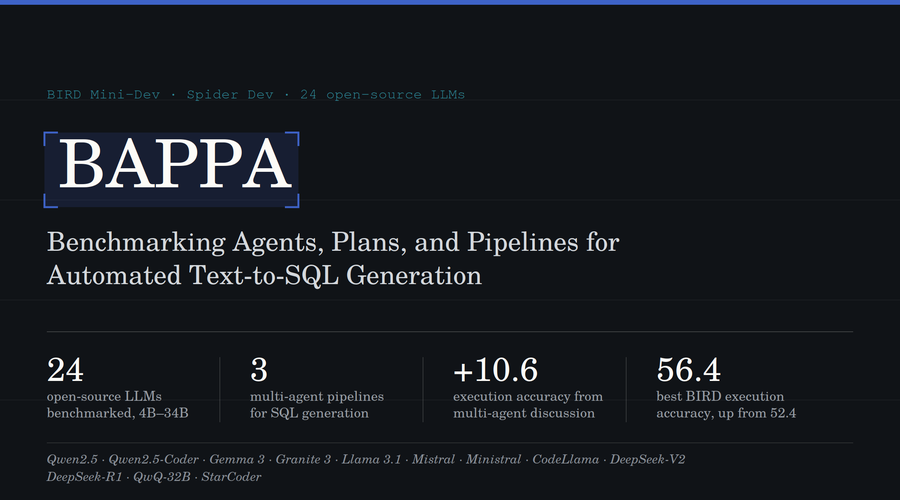
Text-to-SQL systems provide a natural language interface that can enable even laymen to access information stored in databases. However, existing Large Language Models (LLM) struggle with SQL generation from natural instructions due to large schema sizes and complex reasoning. Prior work often focuses on complex, somewhat impractical pipelines using flagship models, while smaller, efficient models remain overlooked. In this work, we explore three multi-agent LLM pipelines, with systematic performance benchmarking across a range of small to large open-source models: (1) Multi-agent discussion pipeline, where agents iteratively critique and refine SQL queries, and a judge synthesizes the final answer; (2) Planner-Coder pipeline, where a thinking model planner generates stepwise SQL generation plans and a coder synthesizes queries; and (3) Coder-Aggregator pipeline, where multiple coders independently generate SQL queries, and a reasoning agent selects the best query. Experiments on the Bird-Bench Mini-Dev set reveal that Multi-Agent discussion can improve small model performance, with up to 10.6% increase in Execution Accuracy for Qwen2.5-7b-Instruct seen after three rounds of discussion. Among the pipelines, the LLM Reasoner-Coder pipeline yields the best results, with DeepSeek-R1-32B and QwQ-32B planners boosting Gemma 3 27B IT accuracy from 52.4% to the highest score of 56.4%.
@article{ahmed2025bappa, title = {BAPPA: Benchmarking Agents, Plans, and Pipelines for Automated Text-to-SQL Generation}, author = {Ahmed, Fahim and Ahasan, Md Mubtasim and Monon, Jahir Sadik and Wahed, Muntasir and Amin, M Ashraful and Rahman, A K M Mahbubur and Ali, Amin Ahsan}, journal = {arXiv preprint arXiv:2511.04153}, year = {2025}, } - Learning Heterogeneous Agent Collaboration in Decentralized Multi-Agent Systems via Intrinsic MotivationJahir Sadik Monon*, Deeparghya Dutta Barua*, and Md. Mosaddek KhanIn Proceedings of the 24th International Conference on Autonomous Agents and Multiagent Systems (AAMAS), 2025
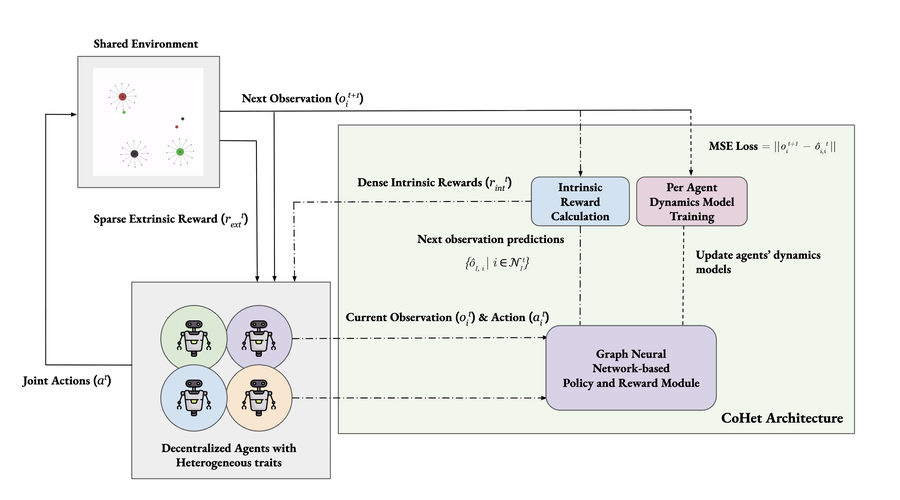
Multi-agent Reinforcement Learning (MARL) is emerging as a key framework for various sequential decision-making and control tasks. Unlike their single-agent counterparts, multi-agent systems necessitate successful cooperation among the agents. The real-world deployment of these systems requires decentralized training and execution (DTE), diverse agents, and learning from infrequent environmental rewards. These challenges become more pronounced under partial observability and the lack of prior knowledge about agent heterogeneity. While notable studies use intrinsic motivation (IM) to address reward sparsity or cooperation in decentralized execution settings, those dealing with heterogeneity typically assume centralized training for decentralized execution (CTDE). To overcome these limitations, we propose the CoHet algorithm, which utilizes a novel Graph Neural Network (GNN) based intrinsic motivation to facilitate the learning of heterogeneous agent policies in fully decentralized settings, under the challenges of partial observability and reward sparsity. Evaluation of CoHet in the Multi-agent Particle Environment (MPE) and Vectorized Multi-Agent Simulator (VMAS) benchmarks demonstrates superior performance compared to the state-of-the-art in a range of cooperative multi-agent scenarios.
@inproceedings{monon2025cohet,
  title = {Learning Heterogeneous Agent Collaboration in Decentralized Multi-Agent Systems via Intrinsic Motivation},
  author = {Monon, Jahir Sadik and Barua, Deeparghya Dutta and Khan, Md. Mosaddek},
  booktitle = {Proceedings of the 24th International Conference on Autonomous Agents and Multiagent Systems (AAMAS)},
  year = {2025},
}
2023
- Dataset
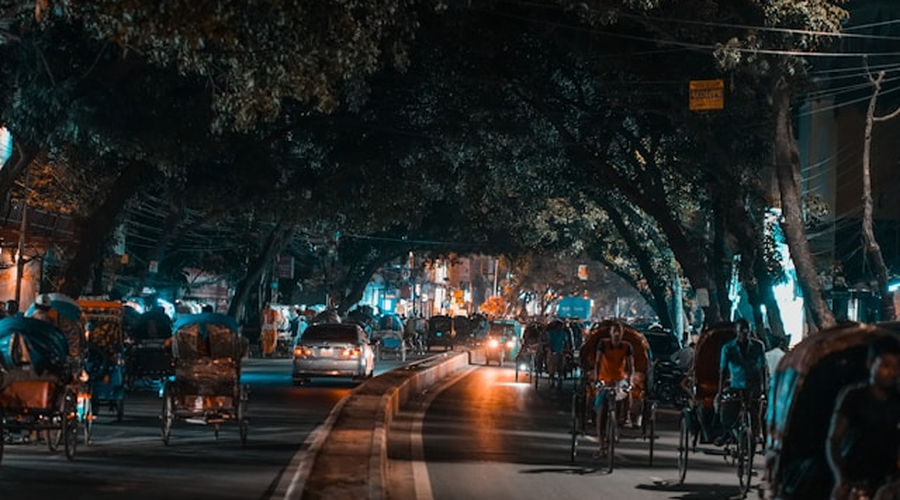 Insights into Dhaka City’s Walkability: A Crowdsourced DatasetJahir Sadik Monon2023
A crowdsourced research project with a team of around 70 junior-year CSE students at the University of Dhaka to collect and analyze a dataset on the walkability of areas across Dhaka city. Data on road surface quality, footpath availability and width, traffic congestion, noise pollution, street lighting, and signage were recorded with the Gaia GPS app, cleaned, and analyzed to identify factors that shape pedestrian experience in the city.
@misc{monon2023walkability,
  title = {Insights into Dhaka City's Walkability: A Crowdsourced Dataset},
  author = {Monon, Jahir Sadik},
  howpublished = {Kaggle dataset},
  year = {2023},
}